Monday, May 24, 2010

Marlise’s Blog May
It’s hard for me to believe that I have already been working here for 5 months. I started as an archaeology intern here in mid-January after leaving the snow back home in Colorado. After a couple of months of living in the tents at Cinnamon, I finally got used to the cold showers and cooking on a gas burner. I would fall asleep to the sound of waves at night and wake up to lizards scurrying up the walls in the morning.
Moving here and working with Caribbean archaeology was very different than the south western archaeology I was familiar with. I had been working for an archaeology firm in western Colorado doing artifact drawings, graphic design and a variety of lab work. My first weeks down here were spent reading and learning about the history of the Virgin Islands.


Marlise in the excavation unit at Cinnamon

I have been impressed learning about the richness of the Taino culture. The artwork they created was rich in symbolic and religious meaning. The artifacts collected during archaeological excavations here on St. John include stone carvings and shell beads, ceramics adorned with human-like sculptures , as well as historic European artifacts People have been living on St. John for over 3000 years, with a history spanning from prehistoric peoples, European conquest and slave trade to cruise ships and tourism.¬¬
One of the things the interns have been doing here is giving archaeology talks at Maho resort. I watched the presentation a couple of times as the previous interns gave the talk and then gave the talk myself. People seem to really enjoy learning about the place they are visiting and the audience had lots of interesting questions. The most common question seems to be, however, “Why do they drive on the left-side of the road here?” No one really knows for sure, but the close proximity of the British Virgin Islands seems to be the origin. Talking with visitors about the work we are doing here is a big part of our job. Visitors come into the lab on the beach and look around or talk to us while we’re excavating and we’re able to answer people’s questions about the history of the island.
These last few months have been full of many different projects. We have mapped and took GPS points of plantation ruins on the steep hillsides of the island, continued working on the excavation behind the archaeology lab, and gone over to Hassel island for projects and talks. In April a new excavation at Cinnamon started and a crew was hired for the project. Matt, the other intern and I, were on the crew so we moved into housing with the crew chief. We also undertook the Danish International internship program during the month. We had three Danish students, Signe and Stig were our history students here to discover ruins they found in the archives. Casper was here to pursue his research on the prehistoric lithic (stone tools) of the island and how they compare to those in the collections in Denmark. I got to go out with the history students into the bush to help them locate three new plantations that are some of the first to be settled and abandoned on the island. As of this post I am working on developing the first interpretive signs for Hassel Island about the historic Creque Marine Railway.

Monday, May 03, 2010

Karson Winslow, 2010 Intern
A gentleman asked me the other day why I was interning with the National Park Service on St John. He thought that with the bad economy, that had to be the reason why I didn’t have a “real job.” Either that or I wasn’t sure what I wanted to do with my life. I responded with the exact opposite. I know exactly what I want to do in my life and right now, this is it. I joined on as an intern and volunteer because I purely have a desire to be in the field of archaeology. In the field now for a little over five years, I have had the ability to work in some really great places and with very knowledgeable and amazing people. This destination has been no exception.
I went to school in California and attended UC Santa Cruz, receiving a BA in Anthropology (2005). I continued with my education and moved to South Australia to attend Flinders University for graduate studies focusing in Maritime Archaeology (2007). After University, working in a number of places including Tasmania, St. Augustine, Florida, Galveston, Texas and terrestrial work throughout California, I decided to focus on a region I believed would most apply to my studies and experiences.
Being an archaeologist, the system is similar and relatively universal in the different locations where one works, but each individual area brings its own cultural identity. For this reason I choose to explore the past as well as explore these unique entities most people might not even know exist.
For now, I will only be on St. John for a short while, though I intend to return and continue working and volunteering on island in the near future. With the Caribbean being such a “Colonial Melting Pot” if you will, with so many European powers utilizing these waters and these islands, there is a very important history here that belongs to all of these nations, including those who inhabited the islands before.
Days are spent at Cinnamon Bay working in the Archaeology Lab. Work out there consists of informing visitors about the history of the area and explaining the purpose and focus of the work we do. We are also working on cataloguing artifacts from the excavation at Cinnamon Bay that was completed at the Ceremonial grounds of the site, as well as washing and sorting artifacts from a current re-burial project the VINP is presently undertaking. If not in the lab, we are in the field recording the remains of known sites on and around the island or gathering historic data on field artifacts. Such as recording the exact measurements of the one surviving historic marine iron bollard at Creque Marine so that identical ones can be reproduced as part of a park funded project that is aimed at providing safe docking for visitors while maintaining the historic scene.
I would just like to say a quick thank you to the supporters and Friends of the National Parks, without whom it would not be possible for the interns and myself to be here. I very much appreciate the support and generous donations towards the park.
Karson Winslow

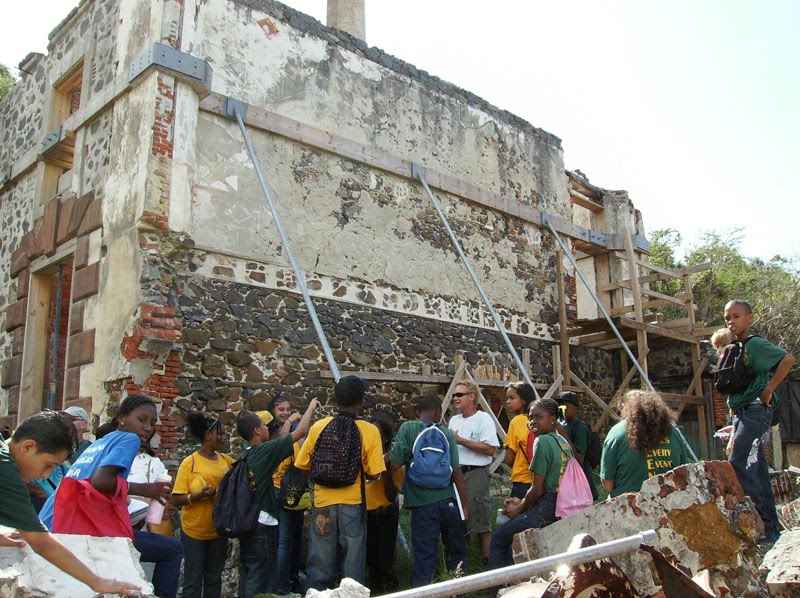
Ken giving an educational tour to a St Thomas school group at Creque Marine. While we interns recorded artifact data.

Marlise recording Bollard data for reproduction.

Wednesday, March 03, 2010

Hassel Island Day Trips

As of right now, a project is taking place on Hassel Island, just off of the island of St Thomas. The small island has had many uses over the years and numerous structures and features remain visible today. Currently the interns are partaking in recording officer barracks, long houses and other structures located there. This involves taking measurements of the in situ structures and noting any artifacts located on the surrounding surface. These structures in particular, all that is left at the surface are parts of the side walls and staircase. The dimensions are taken and recorded; orientation of the building is noted and any other important details that might reveal pertinent information to the location.

A group of volunteers, including Volunteer Coordinator Jeff Chabot, National Park employees, Thomas Kelley, Ken Wild, Lauran Riser and interns Marlise Reed and Karson Winslow rounded out the team of jungle cutters going to clear paths to the archaeological sites in question. With machetes and loppers in hand a trail was blazed through the lethal Christmas Bush, Cacti and other thorny flora. Did I mention that the sites were also located on the top of the hill? We really appreciate the great help of the volunteers who came out with smiles and packed lunches to spend the beautiful day clearing bush for the archaeology to happen.

We had some time to record a Leprosarium with a cistern attached.


The majority of the day was used clearing bush, which gave little time for recording. We plan to return to the site for more recording in the future.

The next visit was done in conjunction with a day trip kayaking company ran out of St Thomas bringing a group of roughly 20 visitors. Ken Wild conducted a great four hour tour of the island starting at Creque Marine Slipway, the oldest and largest known steam powered marine railway of its time. It was built by the Danish in 1840 and many of the parts are located on site today.
This day didn’t involve fieldwork by the archeologists, but functioned as great tool to learn more about the history of the area.

The last trip out to Hassel, we met up with a group of Army National Guard men and women, who are based in St. Croix; all having served in Iraq or Afghanistan. Ken gave them a tour while Karson and Matt recorded historic slipway features. These features were recorded in part to historically recreate the slipway authentically. Thank you very much to the St. Croix group for a great day!!

Thursday, November 12, 2009


My name is Eric Vane and I am a newly arrived archaeology intern courtesy of the Friends of the National Park Service. I graduated from Beloit College in the great state of Wisconsin (which was experiencing 35 degree weather when I left) with a B.A. in Anthropology. After spending a summer walking cornfields for an archaeological firm in northern Illinois I am more than excited to escape to warmer climes and tropical jungles.
This is my second stint on St. John with Ken Wild, and The Friends of the National Park Service. My first experience lasted three weeks from May to June of 2008 predominantly on Hassel Island. I assisted with the surface collection of the Leprosarium/ Yellow Fever Hospital, and helped process the artifacts. I also worked with several Danish students who were exploring the history of Hassel Island by using the archives on St. Thomas, and St. John.
So far my six days back on St. John have seemed like a vacation in comparison to last year. Instead of hard cots and platform tents at Cinnamon Bay we have fans, electricity, and… gasp… real mattresses at Maho Bay. Instead hacking through dense jungles of thorny plants, and poisonous brush we have been in padded chairs in air conditioned labs; we know this will end soon. Despite the air conditioning we have all been eager to get into the field, and so today we went to investigate a reported gear/ship wreck off Henley Cay on the South western side of St. John. After setting anchor Katherine, Margaret and I snorkelled along the coastline until we encountered the reported “gear”, which turned out to be an old airplane engine. While Ken was diving the site and recording the find we also found some additional wreckage including what we anticipate is the plane’s wing and the wreckage of a sailboat they may have crashed into the island and sunk during one of the many hurricanes that have hit the islands in the last few decades.
Margaret and I are getting ready to move into the Cinnamon Bay campground on November first, so we shall enjoy our last few days with the fans at Maho. We have opened up the Cinnamon Bay lab, cleaned it out, and spent a couple days there this week washing ceramics from the Cinnamon Bay excavation. We also reopened an old excavation unit nearby, which has lain dormant since 2007 with the exception of a colony of biting ants whom were busy doing their own excavation. Only one 10 centimeter level has been excavated here and already a Danish coin, the smallest Taino shell bead to date and an eye inlay for a Taino wooden Zemi statue. This unit is being excavated for the reburial of the human remains that have eroded from the shoreline at Cinnamon Bay. This excavation will be stopped again for a short time as we once again travel to Hassel Island. This time we will be monitoring the removal of a very old dump at Careening Cove. There is no telling what we may encounter as the cove has been used for centuries.
Unfortunately today is Chela’s last day of work, and we will hate to see her go. Other than that I am excited to be back in the Virgin Islands, and am having a great time.

-Eric Vane-

Thursday, September 24, 2009


My name is Chela Thomas and I have been working for the National Park Service for a few months now. In this time, I have been trained in the preservation of artifacts from various places on St. John and from an old Yellow Fever hospital and Leprosarium on Hassel Island. My appointed tasks included making bags and tags for the artifacts as well as washing them at times. I am able to catalog the artifacts and verify that everything from the site that I was working with is accounted for and included in the reports.

I grew up on St. John and I recently graduated from the University of the Virgin Islands with a Bachelor of Science in Biology. I have been travelling between St. John and St. Thomas for as long as I can remember, so being able to work with the different artifacts has opened my eyes to the way things were. This is my second summer assisting with artifact preservation and I have come to enjoy it very much. My duties last summer included cataloging the historic photographs and some of the same things as now.

While working on the artifacts form the Leprosarium, I took a particular interest in the bottles fragments. I wanted to know what different types of bottles were used for and how they were made. I learned that most of the bottles I had encountered were used for medicine or alcohol. As I cataloged artifacts from other sites, my interest grew from just bottles to glass in general. I wanted to know how the different types of glass got their distinct colors. My interest in glass got me into trying to analyze different types of finishes and trying to guess what the bottles would have been used for. While most glass is undiagnostic, there are some bottles and maker’s marks that have specific date ranges attached to them.

In addition to glass, I recently have gained an interest in different types of ceramics including porcelain and shell edged wares. The variety they contain is amazing. Each pattern has a different date range but they tend to overlap in certain cases. Some of these ceramics are still in production today and even though they are mass produced, they look the same as they did when they were first being made.

Finally, due to my background in science, I was asked to assist Susanna in the conservation of archeological metals. This involves the use of chemical indicators and titration to determine the level of chlorides still present in the metals. We are trying to look at the chloride levels on a monthly basis and just received funding to improve our conservation set-up with new tanks and more sodium carbonate.

On the whole, I feel that my experience here has deepened my appreciation for the islands and I hope that I can continue my work here.

Friday, September 11, 2009

Hello from Margaret!


Hello Everyone! I’m Margaret McWhorter, one of the new archaeology interns. I’m from South Carolina and graduated from the University of South Carolina (the real USC) this past December with my bachelors in Anthropology and Russian. My main focus in school was prehistoric archaeology and I am so excited about St. John’s prehistoric offerings. Today is my second day here and I am already getting exposed to lots of different areas of National Park Service life. This morning we had a large meeting with the National Park Service regional directors and other regional bigwigs. Later on today Ken, Kathryn, Lauran and I are going out to Trunk Bay to survey the ruins of the former manager’s house. Everyone has been so warm and welcoming; I couldn’t be happier to be down here working in such a beautiful place. I really want to thank the Friends for making this possible.

Thursday, June 25, 2009

"More Than Science"


By: THE 2009 DANISH INTERNS

Imagine coming from a neat, cold little country, where there is no wild nature what so ever and where each science and each university department live their separate lives in a public funded coziness. When you live in a place like that and you go abroad to do scientific research in the U.S. Virgin Islands, it is not only the science itself which will be a challenge.


In May 2009 we were a group of five students from the Saxo-Institute University of Copenhagen (history, archaeology and ethnology), who became interns for the National Park Service (NPS) program on St. John. The purpose of the trip was to solve the mysteries of the eighteenth century plantations on the Northeastern part of the island. A trip that not only gave a much better impression of the living conditions at the plantations, but also loads of tropical experiences.


We already started out in February by tracing and studying old archival material regarding the eighteenth century plantations on St. John in Copenhagen. When the Danes left the West Indies in 1917, they took most of the archival material with them home to Copenhagen. Furthermore, much of the archival material is written in Danish, so cooperation between N.P.S. and University of Copenhagen was obviously beneficial for all.

After three months of archival studies and preparations in general, we went to St. John to investigate our archaeological project area. Together with NPS archaeologist Ken Wild, we explored the rough landscape around Brown Bay and the East End.

The hills on St. John are a rocky and steep climb in an unfriendly jungle; that is if you come from the flat and cultivated Denmark. So, we did not only face tremendous academic challenges but also physical ones. The bugs, the heat, the vegetation and the landscape were all hard but very giving and fun experiences that helped to expand our views of fieldwork.

Thanks to the competent leadership of Ken Wild, we all managed to make it through and find many of the plantations described in the written sources for example: an old Danish document describes a main house situated on the hillside west of the bay at Brown Bay. This source led us to an undiscovered ruin with artifacts dating from the eighteenth century. In general through the dating of the artifacts we found at the plantations, which were mainly potsherds, it was possible to some extent to decide when the plantations were inhabited. The fieldwork and the archival research will be joined together in several reports, which will contain our final findings from the internship.

It is our hope that people in future will be able not only to visit the ruins but also to learn about the people who actually lived there. There is still more work to be done, but we are glad to have been a part of it.

We are very thankful to the Friends of the Virgin Islands National Park, Ken Wild and the National Park Service who made this great experience possible.


Hi, Lauran here again. I finished my Master's thesis and graduated and was able to make it back to St. John in time to experience the last week of the Danes' internship!! To re-cap, while the Danes were here, 7 new plantation sites were found including 2 new sites that we stumbled upon while looking for another plantation!! So, lots of excitement, but this means we have a lot of work to do! I'll be heading into the lab this week and next week to finish analyzing the rest of the artifacts from these sites so I can get the Danes the artifact date ranges to go in their reports. Don't forget to stay tuned this summer for our next adventure in archaeology!

Monday, May 18, 2009


Hey all! Katie here; unfortunately, writing for the last time. My time on St. John has come to an end. I’m headed back to the Midwest to continue work, look into several graduate school opportunities and in June I’ll be headed back to the Middle East to continue work at an archaeological site I worked on last summer. These past months I’ve had an incredible time doing archaeology with the National Park on St. John! I’ll miss it; but most of all, I’ll miss the people I’ve met and worked with during my stay. Ken, Rafe, Susanna, Jeff, everyone at the biosphere, the volunteers and everyone at the Friends of the VI National Park office, thank you just doesn’t cover my gratitude. I owe you all for giving me this spectacular opportunity. I’ve learned and experienced so much; from metal conservation and operating fickle Trimble GPS equipment, to report writing and making a tent home. Thanks for the memories everyone!

Thursday, March 19, 2009

From Vibe and Andreas on making the Hassel Island Report

Hassel Island 1688 – 1801
An unusual Plantation

Prepared for the National Park Service, US Virgin Islands
Andreas Latif & Vibe Maria Martens, University of Copenhagen


1. The making of the report
2. How it was to read ”the obsolete language” of gothic Danish hand writing:
i.e. Mr “Hot king son”
3. What was the most extraordinary thing about researching in the archives
4. The most difficult thing about writing the report
5. What we think about the outcome of the research

1.) When we started writing our report back in February 2008, the general plot of the report was actually already in place. One month early Vibe and I were presented with the proposal that we could write the early history of Hassel Island, which meant everything as far back possible before the first British invasion in 1801. We knew from looking at the old maps and photos, that Hassel Island would be a somehow tropic and very Caribbean experience. However, Hassel Island would prove to be a different encounter, then that we had in the beginning of the process, where we were merely looking at photos and maps of the island. Together with Ken Wild and Niklas Thode Jensen we decided to focus on writing the story of early life on Hassel Island, a story stretching from 1688 to 1801, the starting point determined by which sources was available in the National Archives. Back then one should remember that Hassel Island was an isthmus or peninsula; first in the 1860s did it become the island that we know today. What we wanted to achieve with our report was to uncover who and why people lived on Hassel Island. A task that was as amusing as it was difficult.
2.) From February 2008 to the start of May 2008 we spent nearly every day in the Danish National Archives searching for owners of the Hassel Island plantation. Sitting in the archive amongst all the old boxes with documents that have not been opened for centuries makes you feel rather humble, but also privileged. The worst thing about being at the archive is that you use the first 3 weeks to learn the difficulties of the gothic style hand writing. However, once you have cracked the code it is a great achievement to have accomplished. One of the funniest memories from the archives was when we stumbled across a guy from the 1730s called Mr.“Hot king son”. One thing you have to remember when you are sitting in the archives is to be very quiet - but when we when found this guy “Hot king son” we were in fits. This Mr. “Hotkingson” was probably a Mr. Hutchinson, but because the Danish clerks were Danish (obviously) and because there were no tradition of “correct spelling” as we know it today; as well as the clerks probably had difficulties pronouncing the “tch” in Hutchinson, the name was spelt in this rather amusing way. Mr. Hutchinson became a Mr. Hotkingson.
3.) The most extraordinary thing about being in the archives was when we struck gold, for example when we discovered one of the owners had been murdered on Hassel Island, and subsequently were able to uncover the police report and the document listing the administration of the estate. Sitting day in and day out without making significant progress can be quite demanding. But then, when you least expect it, the information you were hoping for will show up, and that is a wonderful feeling, when you can tie up loose ends and uncover new histories.
4.) Looking back at the process the most difficult phase of the writing process was combining the archaeological findings on Hassel Island with the archival findings from Copenhagen. We were not certain at any point in the writing process whether the archaeological part and the archival parts finds respectively would support one another. Yet another aspect in writing the report was the fear of writing something uninteresting and irrelevant. However, when we got back from the U.S. Virgin Islands and read the report again, it wasn’t half bad; so that was a nice surprise.
5.) The outcome of this project between National Park Service and Copenhagen University is a 100 page long report which contains the early history of Hassel Island. We are quite happy about the result of our report. We have been very pleased with this opportunity to really study in depth and it has been a great experience being in the U.S. Virgin Islands. Last of all, is that it has been a great pleasure working with Ken, Niklas and all the other lovely people we have met in connection with this internship.

Friday, March 13, 2009

Volunteers help clear Sieban and L'Esperance Ruins

St. John's Lone Baobab Tree, Sieban Plantation Ruins.

Hey everyone! Katie again, just wanting to get everyone up to date with what has been happening in the archaeological world here on St. John. Sadly, Jen recently returned stateside to continue working for the University of Iowa and Lauran has left as well to finish her Master’s thesis. Everyone here at the Biosphere misses them both already! However, our new archaeology intern, Andrew, is here! He’s another Midwesterner, like me, and is thrilled to be working with the National Park Service doing archaeology on St. John.

Since the last blog entry in mid-January, work has been moving along at an inland historic plantation site known as Sieben. With the help of National Park volunteers clearing brush from the surviving structures, we’ve been able to complete our surface collection and map all artifacts using our GPS unit that gives us up to 10 centimeter accuracy if the vegetation is reduced. We must recover this surface material now that visitors have been directed through the ruins by a new trail. It is important that we get the artifacts where they were left historically. This information can tell us so much about the site like how old certain sections and buildings are, different activity areas and about the people who lived and died here. So please if you see an artifact leave it and let us know. We have recovered a wide variety of interesting historic ceramics that were produced throughout Europe, also bottles, and even a large iron cooking pot that could be from the early 1700s. Some of the household ceramics that we’ve collected are datable to the early 18th century up until the mid-20th century.


Lauran, Jen, Katie and Ken, after a surface collection at Sieban.


Land list records indicate that Johann Hienrick Sieben owned the land and built his plantation in 1718, making Sieben plantation one of the earliest on St. John. So far, artifacts collected from the surface number over one thousand and we’re not done yet. Lauran’s knowledge about historic ceramics is impressively extensive and over the past few weeks, she’s been teaching me all she knows about analyzing the historic ceramics that have come from Sieben. On a side note, one of the fantastic natural features present at the site is the African Baobab tree. Growing along the edge of the ridge overlooking Reef Bay, it is only one of its kind still present on the island.

A big thank you needs to be given to all the folks who have volunteered their time helping us clear and cut brush from the ruins over the past few weeks. We really couldn’t have done all that’s been accomplished with out you.

Jeff Chabot and his crew of hard working volunteers, on the Grand Staircase at Seiban.

Speaking of volunteers, Lauran, Jen, and I had a potential archaeologist helping us wash the artifacts from Sieben at the Cinnamon Bay lab. Thanks for your help Tralyn!


Clearing began last week at L'Esperance, another plantation located in the same valley, from the same time, but just north of Sieben. We’ll keep everyone up to date with what is happening and what we find out about this plantation in the coming weeks.


L'Esperance Ruins

Tuesday, March 03, 2009

Lauran's Farewell


Hi, again! It’s Lauran. Well, I’m very sad to say that this will be my last blog entry…for a while at least. I’m heading back to South Carolina to finish my Master’s thesis, then preparing to go to West Africa for Peace Corps. I cannot even say how much I’ll miss St. John, especially doing archaeology here! I’ve been so lucky to work with such great people here; Ken, Susanna, Katie, Jen, all of the park employees at the biosphere, Jeff and all the wonderful Tuesday/Thursday volunteers. The volunteers have really helped us get the plantation ruins cleared so that we can do the archaeology and GPS the structures. This has been a dream opportunity for me to do archaeology here because the island has so much history and many well preserved sites! I’m going to miss working with everyone and I’m really going to miss the island! I want to thank Ken Wild for giving me the opportunity to work here and I want to thank the Friends of the Virgin Islands National Park for their support!! I hope to come back soon!!

Friday, January 09, 2009

Hello everyone!


Hello everyone! This is Jennifer and Katie, the newest interns here at Cinnamon Bay for the National Park Service. We’re both from the Midwest (Iowa and Missouri respectively) and are just grateful for this amazing opportunity to get away from the ice and snow for awhile! We’ve been here for about 3 weeks and we’re already learning so much about the history of St. John and life on the island. The people here have been incredibly accommodating and have all done so much for us during the process of settling into our new home. Working at the archaeology lab/interpretive center at Cinnamon Bay has helped us to really understand more about the variety of people and cultures before us who have called this island home.
Most of the work has involved analyzing artifacts at the Cinnamon Bay lab, recovered from various historic colonial sites around St. John, and informing the visitors to the area about the island's history. We’ve enjoyed meeting everyone that has come to visit us at the lab. A few days ago, we were thrilled to have our first lesson using GPS equipment to record the locations of multiple artifacts at a particular site. We were conducting a ground survey to look for sites on a newly acquired area for the National Park Service and found some interesting archaic artifacts. Jen found her first flake!


Before and AFter images of the RMSPC Clean Up


Last week we had the opportunity to tour the archaeological sites of Hassel Island and witness the clean-up of the Royal Mail Steam Packet Company. Just recently we’ve been learning about the NPS’s artifact cataloguing system and all the work that goes into recording a site. While in the lab a few days ago, we put together a wonderful display of the different types of historic ceramics that are found on the island. This display will be used as a demonstration piece for talks given about the historic occupation of St. John.


So much has happened within the last week that we’re sure to be busy for awhile! In fact, today we were able to help move a swivel cannon to the archaeological lab at Cinnamon Bay. There it will begin the restoration process that we will conduct and monitor for the next few months. This is an extremly exciting opportunity for us and we’ll keep you posted on how things are going!


Jen and Katie

Tuesday, December 16, 2008

Season's Greetings from Two New Interns

Hello! I’d like to reintroduce myself. I’m Mick Wigal and you might remember me from way back at the beginning of this blog. I helped start this blog when I was an intern several years ago. Since then I went off and received my Masters Degree in Anthropology from The University of South Carolina and now I’m back to intern for awhile before my next adventure, the Peace Corps. And with me came a new intern.


Hi, everyone! I’d like to introduce myself. I’m the new intern, Lauran Riser and I am so excited to be doing archaeology down here in St. John! I received my undergraduate degree in Anthropology in 2004 from the College of Charleston and am currently finishing my M.A. in Anthropology at The University of South Carolina. Like Mick, I’ll be interning here for a couple of months before I go off to West Africa for the Peace Corps!


In archaeology news, Mick and I have been working on a project at Big Maho Bay that commenced in June of this year. The land has recently been acquired by The Trust for Public Land for the park. Since the park is going to build a gravel parking lot to keep beach-goers from parking on the streets, archaeological testing is being carried out to locate and protect valuable cultural resources from impact at the parking lot. The remains of an historic brick oven, although damaged from a fallen palm tree, are visible on the property today.


This land was owned by Willem Vessup, a large landholder on St. John. Vessup had committed a murder. He attempted to use the 1733 slave revolt on St. John to be pardoned for this murder. He tried to lure the rebel slaves onto his boat in exchange for gunpowder. If successful, he would then capture the rebels and use them as a bargaining chip. Fortunately for the rebels, they did not enter the boat and were able to fight on.

To date, we have conducted six shovel test pits, in addition to the four previously done. Most of these shovel test pits are around the bake oven and in areas known to have been occupied even into the 1990s. Although we have found some examples of prehistoric pottery, which confirms a new prehistoric site for the park, most of the artifacts recovered are historic and date from the late 17th century to early 20th century. Two unique artifacts have been found so far. One is a Danish West Indies One Cent coin from 1913. It is heavily corroded but there is just enough writing to identify it. The other is a pipe bowl with a cross-hatched heart on one side and a human hand on the other.

We are hoping to complete four more shovel test pits before Christmas. We will be placing these pits on the edge of the swampy area to test for a likely Taino Indian occupation. Be sure to keep visiting our blog to stay abreast of the next exciting discovery around the corner. We almost forgot to say hello and welcome Jennifer and Kathyrn who will arrive after the holidays from the midwest and Ken tells us there will be at least three new Danish interns that will be arriving in May 2009, Agnes, Marie and Galit! Hey ya’ll!

Thursday, November 13, 2008

Stabilizing a ceramic vessel in the collection

Greetings. I’m Paul O’Dell, visiting VIIS from Santa Fe, NM, where I’m the Archivist for the Submerged Resources Center. I’ve come to intern at the Virgin Islands NP museum collection for one week to expand my knowledge of different collections in different parks and to hopefully assist in any way that Museum Curator, Susanna Pershern, sees fit.
What a collection! The Island’s amazing history, both cultural and natural, is very well represented, from the most beautiful (and well cared for) accessions of pre-historic Taino pottery and bone carvings, historic accessions from the Island’s dark days of slavery and revolt, to items and equipment reflecting the era of sugarcane plantations and rum estates. Also represented are significant and symbolic items relating to the history of the presence of the National Park Service on the island, which as an archivist for the NPS, I find very interesting. The Natural History Collection, however, is exceptionally amazing (I do have to disclose that my background is in biology, so I’m a bit biased). The collection consists of over 2000 specimens representing nearly all of the rich and diverse life which can be found on St. John and the surrounding waters (although donkey and cat specimens have yet to be included). It is a working collection, in that daily specimen condition monitoring and maintenance takes place, and the associated specimen database (the unexciting yet critical element to any collection) is current and correct. This is not an easy job, and every credit should be given to Susanna for maintaining the collection the way she does. I’ve seen other museums under ideal circumstances (i.e. not on a remote island and with PhDs swarming around) that were not half as well maintained and accessible for research.


In addition to curatorial and museum administrative work, some time has been found for other important tasks which are all day-in-the-life work for a curator at VIIS. There is checking on the Archeology Laboratory at Cinnamon Bay (swimming in the ocean on our conveniently timed lunch break), taking pictures of cats and chickens on the beach for the biologists(life is rough), and staring across the Caribbean Sea from the back porch of the office on our federally mandated 15 minute coffee breaks.
All in all, this has been an amazing opportunity. To work with one of the most talented and resourceful employees that the NPS has to offer in one of the most beautiful and resource-rich parks under NPS administration is truly an honor. I would like to thank the Resource Management team at VIIS for sacrificing Susanna’s time for a week to accommodate me and demonstrate to me her devotion to the NPS mission of resource stewardship.