Monday, September 08, 2008

Hi’ Everybody

I’m Casper Toftgaard Nielsen, one of this year’s Danish Interns from Copenhagen University in Denmark. The first time I heard about the National Park on the US Virgin Islands was in October 2006, when I saw an e-mail advertisement about a 2 person Internships with the US Virgin Islands National Park Service in a joint venture programme with Copenhagen University; the program offered academic credits, a free plane ticket, free lodging, and, best of all, a one month stay on the US Virgin Islands doing research with the US NPS Archaeologist on St John and Hassel Island.
That wasn’t bad, I thought, but due to other commitments I couldn’t apply straight away. So I waited with, some trepidation, until October 2007 to see if the program continued into 2008. It did, so I applied and got into the interview round at Copenhagen University …. And got a lucky, unexpected and unplanned for 3rd slot in the program. Much of this was due to my background as a former Naval Officer in the Royal Danish Navy, as Ken Wild, the USVI NPS Archaeologist on St John, had quite a few maritime projects he wanted me to look into at the National Archive in Copenhagen. Briefly listed below in the “initially” prioritized order:

1. Historical Shipwrecks on St John.
2. Historical permanent moorings or anchorage in the outlying bays of the St. John.
3. General information on Danish naval and commerce activities, for example the type of ships and boats used in the sugar industry, military patrols, etc
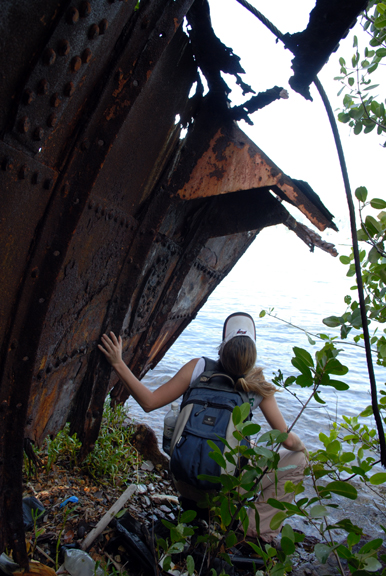
4. Information on the double ended coal barge used by the American Hamburg Line and now lying as a rusty hulk in Careening Cove on Hassel Island.
5. Establish a list of pirates and privateers operating in or around the USVI.

Quite a mouthful to say the least, but theory is one thing and practice is quite another thing, as everybody knows, and events were to take us through a somewhat different, but very, very interesting and exciting path, where I got to look at all the subjects to varying degrees. Even though we all knew beforehand that I would ultimately have to focus on one or two projects due to time limitations back at Copenhagen University.

So when I arrived at St John on the 20th of April 2008, I had looked into the all the dusty and worm eaten papers that I could lay my hands on back in the old, cosy National Archive in Copenhagen to have as many notes as possible to be able to give the VINPS Archaeological and Historical Staff an idea about what we could expect to gain by working jointly with the literary (in Denmark) and archaeological sources (In the V.I.).

Initially I got myself a little surprise though, as Ken Wild and Susanna Pershern (The NPS Archaeological Staff) were busy with the Sea Salvage Company clearing the bush in the area around Shipley Battery on the Northern top of Hassel Island and needed my help to do a land-survey in the immediate area around and inside the battery, before the Sea Salvage guys moved in with the heavy clearing equipment. Luckily, Ken had prepared me that this would probably happen, so I had brought with me: my desert booths, desert trousers, camelback and jungle hat from my Navy days. And secretly I was also really quite excited about getting into the bushes and shrubbery and the Catch & Keep, the Pinguin and the Christmas Bushes, as we have nothing comparable in Denmark and I look at (almost) every new experience as something positive. A few weeks later, I had gotten my fill, especially of the Christmas Bush and to some degree the Catch and Keep, as I expect most local Virgin Islanders have, but that was to come later on. Initially I just enjoyed myself immensely surveying, clearing the shrubs and exploring the northern part of Hassel Island. Where we also looked for the abandoned Hassel Plantation buildings besides clearing around Shipley Battery, but without any positive result with regards to the Hassel Plantation Buildings, even though we found a lot of ruins and an old cemetery, but they where probably all from a later time period and most probably from the English occupation in 1801 and again from1807-08/1815.

The second week we started to look into the subjects I had researched in the Copenhagen and especially the question: Had there been established permanent moorings or anchorage in the outlying bays of St. John in the historical period between 1680 and 1850.

We already knew that there had been plans for this in Charlotte Amelia Harbour in 1802, even though it wasn’t effectuated until some years later, we also knew that General Governor Peter von Scholten had also issued regulations around 1825 about the safeguarding of smaller boats, ships and canoes to prevent slaves from escaping to Puerto Rico where it is mentioned in the regulations that mooring poles or anchoring buoys should be locked securely. This proves that the local Planters and Sailors used these techniques around 1825-29.

But the question Ken Wild really wanted answered was, if the several historical anchors that had been found through the years had been used for just that or if they had been lost or used for other purposes. This could only be researched properly by diving on the anchors and the ballast piles from the old wrecks to note their dimension, constructions, general appearance and their positions on the bottom relatively to the surroundings and especially to the reefs around them. Because we were quite sure that the sailors of former days, just like sailors of today, would chose good sandy bottoms that ensures good holding, while they would try to avoid corals and rocky areas, where you risk getting your anchors stuck and, even worse, losing it if you can’t get it untangled. An operation which must have been a some what more difficult proposition in the historical period than today, where scuba divers can help the unlucky captain without “too much” difficulty.

One thing more we had to look after, was if the anchors where of the “Corps Mort” type, that is to say, if one of the Arms of the anchors was missing, as that was a quite common damage to anchors in the historical period, as the welding techniques during anchors production was almost impossible to control, which meant that ships often damaged their anchors and as a consequence had to carry between 4-8 anchors to ensure they had enough workable anchors compared with 1 or 2 anchors on modern ships and boats.


(Corp Mort type anchor, from George Cotsells: A treatise on Ships Anchors, 1856).

The reason why we had to look for these damaged Corp Mort type anchors where, that they were considered useless for normal anchoring, as you couldn’t be sure that they buried they remaining arm and ensure good holding. But on the other side they where excellent for permanent moorings, as they could be deployed in a controlled fashion, ensuring holding ability and at the same time ensuring that there wouldn’t be any anchor arm pointing upward, which lowered the risk of damaging a ship’s bottoms if the wind changed and the ship drifted onto the anchor on the bottom or in a crowded roadstead. So if we found a Corp Mort type anchor, it would indicate a permanent mooring facility, while undamaged anchor would make it more doubtful.

Altogether we dived on 4 anchors and 3 wreck sites during my second week on St. John, but all of the anchors where stuck in corals and always where a sandy and coral reef area joined up, likewise none of the anchors where of the “Corp Mort” type. These 2 fact held together almost certainly proves that the anchors are from ships where the anchors dragged and got stuck in the coral reef maybe even leading to the loss of the ship.


(Field sketch by USVI NPS showing the typical position of an anchor between corals and sand bottom)

This could very well be the case especially in Reef Bay on the south side of St John where there are also historical cannons and several gear rings for sugar mills on top of the Reef close by the anchor. But it could also just be an indication that the crew of the ship has unloaded surplus weight to lighten the ship and get it off its dangerous position on the reef, only further investigations can reveal it.

But it’s almost certain that the historic anchors in around St. John haven’t been used for permanent moorings, neither the placement of the anchors or the anchors themselves fits the historical evidence or the practical seamanship we would expect from sailors. This kind of took the wind out of our (and especially my) sails, as the evidence underwater and the National Archives in Copenhagen didn’t really provide enough material either written or archaeological to allow me to write the article we had hoped for on the 2 first research subjects.

Sources:
Trine Lise Wahl: Kan ankerfunn spille en rolle I en marinarkæologisk funnkontekst? Unpublished Master Thesis from Copenhagen University.
N. E. Upham: Anchors, Ships Publications Ltd. 1983.
Betty Nelson Curryer: Anchors, an Illustrated History, Chatham Publishig Ltd, 1999.
George Cotsell, Ships’ Anchors for all services, London, 1856

But concerns regarding this had to wait a little as we entered my 3 week on St. John, as Andreas and Vibe, the 2 other interns from Copenhagen, Eric and Mandy the 2 interns from Continental US, Holly, a PhD candidate from Syracuse University and a 5 person survey team from NPS regional office in Atlanta landed on St John.
So my third week was spend being “the old hand” with on Hassel Island and on Haulover, the NPS boat, that we used for our daily trips to Hassel Island and the different locations the Atlanta team had to survey and inspect. Of course this limited my own research possibilities somewhat, but as I hadn’t be sailing in the Royal Danish Navy for almost 2½ years, as I spend almost all of 2006 in India and Pakistan as an UN Military Observer and 2007 in the lecturing rooms at Copenhagen Uni, I must admit, that I enjoyed myself immensely just helping sailing the Haulover as a “deckhand” and acting as a “Bush Guide” on Hassel Island.


(Bush Guide on Hassel Island).
One day was very interesting though, from my research’s point of view, as we went to the old keelhauling place in Water Creek in Coral Bay. This place had it all: A cannon placed vertically in the sand ashore making it perfect as a bollard, if you had to keelhaul a ship, besides the cannon there was old building ashore on the opposite side of the creek (perfect as storage for tar barrels, rope, timber for masts and spars etc.) and ballast stones on 2 different places underwater and a wreck buried in the mud. Altogether very exciting, but as I hadn’t done any research on this site at all back in Copenhagen, this will have to be a project for the future.

When the Atlanta Team left after a very productive and enjoyable week, I only had one week left on St John and I was starting to fell the pressure to find something I could write about, that would involve both archaeological material from the Virgin Islands and archival material from the Copenhagen. I knew of course, that I could always write about: General Danish naval and commerce activities, the type of ships and boats used in the sugar industry, military patrols, etc. on which I had found quite a lot of material both in the National Archive and published in Danish, but then my main article would be pretty much a literary work, without using much archaeological material at all, that wasn’t really what I wanted to do.

This left me with the Coal Barge wreck on Hassel Island, the problem with the Coal Barge though, was if the barge was from the Hamburg America Line, because that company was/is a German company, making it more or less certain that the archival material would be in Hamburg, Germany.

But Ken and I agreed that I at least could make a very thorough survey and take extensive field notes on the Coal Barge. So during the last few days I had on Hassel Island, I used my newly acquired skills with a machete and pruned the bush around and inside the barge, to be able to do as many measurements, field notes and take as many photos as possible. Luckily I think this went really well and after I came back to Denmark the Coal Barge Idea has slowly grown more and more in my mind, which have led to the decision, that I’ll do my main article on precisely what I thought lest likely (except for the Pirate thing) when I started out for the USVI in late April.

Finally I’ll like to express my very grateful thanks to the extremely friendly and always helpful NPS Staff, to the Friends of the USVI National Park for their generous financial support without knowing really who I was (but just trusting the USVI NPS and Copenhagen University) and to all the kind Virgin Islanders I meet during my stay and who took me into their homes and showed the most amazing hospitality.

Wednesday, August 27, 2008

Metal Conservation Blog – August 2008


Hello Everyone!
It’s me, Amber Davis. I haven’t written in about a year and I am sorry. I started a metal conservation project with the Virgin Islands National Park Service and have been exclusively working on my project while Ken has been working on Hassel Island with the new crop of archeological interns. My project combines my interest in archeology with my chemistry background, and I am loving it!
I researched the protocols for metal conservation last year and ordered the required equipment and chemicals. Artifacts Undergoing Treatment

This year, I have been treating the metal artifacts recovered from underwater archeological sites at the Cinnamon Bay laboratory. Among the artifacts undergoing treatment are a metal ladle used for applying tar to sails on boats and a porthole, both found at Hassel Island. I place the artifacts in a 5% bath of sodium carbonate, which leaches out the chlorides that cause metal to corrode. When the chloride levels rise in the bath, I have to make a new 5% sodium carbonate solution. The concentration of chloride rises in the bath as it leaches out of the artifact, and then every time I change the bath, the chloride concentration drops to baseline levels. Once all the chlorides have been leached out of the artifacts, then they will be dried with alcohol and treated with waxes and such to protect against further corrosion. Then, the artifacts will be properly preserved and ready for display!
My project has been very exciting for me. In fact, I applied for an art conservation internship at the Smithsonian and got it. I leave St. John in a couple days for Washington, DC and there I plan to apply for graduate programs in material science or art conservation. I want to thank the National Park immensely for the opportunity they have given me here. I have learned so much working with Ken Wild and Susanna Pershern, and I found my career interest in my metal conservation project. Also, thank you to the Friends of the Virgin Islands National Park for their support, and lastly, thanks to the readers for their interest in and support of the Virgin Islands National Park.

Sincerely,
Amber Davis

Thursday, August 14, 2008

Archaeology at an Epidemic Hospital

Greetings! My name is Mandy Barton and I am a graduate student at the University of Tennessee in Knoxville. I interned with the park for 6 weeks during May and June to begin research on my Master’s thesis, which focuses on the 19th century/early 20th century leprosarium/yellow fever hospital on Hassel Island.

The Cistern at the Epidemic Hospital and Mandy gridding the site area.

My main goal during the 6week internship was to strategically survey and record the site. To accomplish this I collected as much of the site’s artifacts as possible; mapped the building foundations and surface scatter of glass and pottery that covered the site; took photographs of everything, from my 2x2 meter grid to the Iguanas living in the old cistern; as well as acquiring GPS points on the site to accurately locate it for future research. On top of that I wanted to analyze as much of the collection as possible before I left. Just the sheer size of the site, as well as the amount of stuff that had been thrown away by the patients at the leprosarium, was amazing, and a little bit intimidating. But once I got past some of the challenges the site posed- such as the unrelenting sun, lack of shade, and constant encounters with “catch-n-keep” that plagues the island- I happily “dug in”.

The history of the hospital remains mostly unknown at this time. When working on a historical site archaeologists attempt to utilize as much of the documentary record as possible, as archaeology and historic texts usually provide different types of information about the same time or place. It appears that most of the documents that may reference the Leprosarium were taken to Denmark when the United States bought the islands in 1917. Luckily for me, Ken Wild and the Friends of the Virgin Islands National Park have created a great program to bring Danish history students to the island to collaborate with the archaeologists and local historians and others interested in the preservation of the island’s past. Hopefully, with their generous help, more information about the hospital’s past will be revealed.

Back to the archaeology. The only structure remaining at the hospital is a cistern (where our afore mentioned Iguanas were living), but there are also three stone foundations remaining within close proximity to the cistern, which may have been hospital and dwelling structures for the patients. Unusual to the archaeology I typically do, there was very little excavation during the artifact recover. This was due to the shallow dirt deposits at the site. The island’s bedrock was encountered less than 20 centimeters below the surface. Therefore the vast majority of the collection of artifacts involved laying a grid consisting of 2x2 meter blocks and surface collecting. This grid helped keep a spatial record of where the artifacts were being collected from. Where an artifact was located, what archaeologists call provenience, is important because it can reveal information about who used it, when and even why- all information that just the artifact by itself can never tell us. Once we finished the collection on Hassel Island, the artifacts were all loaded on the Haulover and boated back to St. John and the archaeology lab at Cinnamon Bay where I began analysis. The artifacts consisted primarily of pottery, or ceramics- broken dinner plates, cooking pots and tea cups used daily by the people at the hospital. Much of these are what we call “transfer-printed” wares, much of it blue-on-white old fashioned patterns like our grandmothers used to have, and stone-ware bottle pieces. I also collected an astonishingly large amount of glass shards- mostly wine and gin bottles. I am still in the middle of analysis, but the wine and gin bottles may have been used for medicinal purposes. We also recovered beads, a marble, and several pipe bowls. An interesting find at the hospital was the recovery of two ceramic dolls parts, which suggests the possibility that children were living at the hospital as well. All these artifacts tell us that there were probably many different kinds of people quarantine together at the site- young and old, rich and poor. The artifact analysis was not completed before my time in the Virgin Islands ended, but I will hopefully be returning next summer to complete this task. I am extremely excited to learn about what all these artifacts can tell us about the lives of a diseased population that was forced to live isolated from the rest of the community.

Being back in the heat and humidity that is eastern Tennessee, I am missing the turquoise sea and white beaches of St. John. My thanks go out to the Friends of the Virgin Islands National Park for their support in bringing me to the Caribbean to do this research. I anticipate returning to the islands next summer to finish my research. Look forward to more updates as we learn more about life in the leprosarium on Hassel Island!

Thursday, June 19, 2008

International Crew Reveals Hassel Island's Secrets

Hi All! This is Holly Norton, one of this summer’s archaeology interns. Currently I am an employee of NPS, helping to complete Cultural Resource projects. I am also a graduate student at Syracuse University, and am here to complete my dissertation research. The last two months have been a blur of activity and scholarly cooperation- through generous funding from Friends of Virgin Islands National Park, NPS Archaeologist Ken Wild was able to bring an international crew of students to the Park this year. Hailing from Denmark, Vibe Martens and Andreas Latif are graduate students in the Department of History at the University of Copenhagen. Prior to arriving on island, Vibe and Andreas spent months in the Danish National Archives pouring over historic documents concerning the earliest inhabitants of Hassel Island; after arriving on island, machetes in hand, the two Danes cut and hacked their way through the dense jungle looking for the stone foundations and artifact scatters of the same plantations they had discovered in the documents. Joining them was their colleague from the Archaeology Department at the University of Copenhagen, Casper Nielsen. Casper is an underwater archaeologist, and was invited to the Park by Ken and the Friends to research historic anchors and the ruins of an abandoned coal barge on Hassel Island, from when Careening Cove served as the repair and refueling station serving the Caribbean.

The presence of ship repair facilities, specifically as related to the American-Hamburg Line was the final enticement for the US government, who bought the Danish West Indies on the eve of World War I to strategically keep it out of the hands of the Germans, as well as have a port for their own use in the Caribbean. Historically, Hassel Island was not the quiet place that it is today, as you look out over the steeply sloping hillsides from Charlotte Amalie. There was ship careening, military fortifications, naval stations, plantations, trade- and a quarantine hospital. Mandy Barton, an M.A. archaeology student from the University of Tennessee began her thesis research on the Leproscarium and Quarantine Hospital, investigating what life was like for the patients who had yellow fever, small pox, leprosy and cholera who lived, and died, on Hassel. Among the medicinal bottles and ceramics, we have seen a glimpse of their private lives through personal items such as beads, doll parts, and marbles. We’re all waiting with baited breath to learn what the artifacts tell Mandy.

Helping us with all this work was Eric Vane, an undergraduate student in anthropology at Beloit College in Wisconsin. In the United States archaeology is one of the four subfields of anthropology, the others being cultural anthropology, linguistics and physical/biological anthropology. Eric joined us to learn the discipline in the field, and quickly took to both the physical labor and intellectual thought provoked by such study.

For a week in June we were further joined by a team from National Park Service Headquarters, in Atlanta, GA, David, Bethany, Cynthia, Josh and Beth (yes- we had two of them!) Their primary focus was on cultural landscapes and historic architecture, and were visiting the Virgin Islands National Park to assess and record the condition of our historic architectural remains on both St. John and Hassel Island. While they were here I also gained valuable experience in conducting these LCS surveys myself, and will be applying that information to several of our sites on St. John.

Although we often scattered across Hassel Island during the day, conducting our various research projects, we all came together in the evenings, discussing and debating what we had found and what it might mean. Although the research itself has been wonderful, the most valuable experience we gained from this program developed by the Friends of Virgin Islands National Park and the National Park Service is the scholarly cooperation that developed between this summer’s team. The mix of graduate and undergraduate students, from various parts of the United States and Denmark, gave us different perspectives and experiences on which to draw, and allowed us to investigate the history and archaeology of the island more fully. Stay tuned for the blog entries from Vibe, Andreas, Mandy, Casper and Eric…

Monday, April 21, 2008

Hi, My name is Sarah Walch. I have been given the great opportunity to work as an intern for the past month and it has proven to be an unforgettable experience. My tasks have varied from data entry, cleaning artifacts, data collection from Shipley's Battery on Hassel, and completing a random inventory of the parks’ artifacts. The park must complete an inventory of the accessions and catalog records every year. Fortunately, this is just a small sample (202) of all of the 550,000 objects in our collection. Some of the collection, such as the insects, mammals, herbarium, corals and rocks are rarely seen, so the inventory is important to account for the object and to also note the overall condition. The whole process only took us a week, which is a vast improvement over previous years, when the collection was less organized and the interns spent weeks in the bally building trying to find one single artifact.

I have challenged myself with new information every single day varying from trying to identify artifacts, their dates, their uses, and the list goes on. When I am viewing artifacts from this island’s history, a series of questions begin to flow. I wonder about the previous owners, what was happening in history, how and if they were affected. The dull moments are non-existent for me as I become wrapped up in my work. The only regret I have is not discovering this opportunity earlier. I have to return to the mainland this summer to finish some school yet I hope to come back to help the cultural resource team.

Thursday, March 27, 2008

Volunteers

Here at the Park, we are reminded every day that volunteers are the driving force behind the preservation of the unique mix of history and prehistory that the Virgin Islands has seen pass by. This island is always revealing something new, something exciting, something that connects us all through culture and we are so glad when visitors and volunteers take an active role in those revelations and preservations. This blog is dedicated to those folks who have rolled through Cinnamon Bay, Hassel Island, and the myriad of other places in this part of the world where we are continualy learning about the past. Please note that this is just a small sampling of people we'd like to recognize...every volunteer and visitor is so important to accomplishing our mission!


Junior archaeologist Austin Allen was visiting Cinnamon Bay with his family and keeping an eye to the ground when he came across a good-sized piece of handbuilt Taino pottery that a crab had brought to the surface in his digging. Austin very intelligently understood that archaeology works on the premise of context and that the pottery would not offer us as much information had he picked it up and brought it to the lab rather than leave it in situ. Therefore, he recorded its place on the ground and came to bring us to the artifact. Thanks for leaving it in place, Austin! You set a very valuable example for others.


Jeff Chabot, pictured above center with a group of volunteers, tirelessly works to keep the ruins on island free of debris and unclogged of weeds and brush so that they may be enjoyed by everyone. This group joined us last week for a hot several hours on Hassel Island clearing invasive species and learning about its history. Jeff always needs volunteers with an interest in taking part in preserving St. John's wonderful maritime and sugar mill/planation history. For more information on how to take part, please contact the Friends.


Daniel, pictured above with intern Katie Fuller made us all smile with his serious interest in archaeology. Many kids who come to Cinnamon Bay would rather play in the water, but our friend here was adament about learning about artifacts and preservation. He sat and gently washed artifacts for over an hour, asking great questions and making smart hypotheses about what the objects represented. He did a great job with helping us to wash Hassel Island artifacts!


Adam White was snorkeling and found a prehistoric pottery sherd that he brought into the lab. Like Adam, we hope that all the visitors that we interact with will come away with a better knowledge of our cultural resources.


! Jillian and Katie Cataloging Creque Marine Surface Collection

My time here as an intern has come to a close and I'm so sad to be leaving island tomorrow to return to D.C. However, I feel very fulfilled by this intern experience and would be glad to speak to other potential interns about what I've learned here. The Park Service in the USVI has a small but spirited team, and I was glad to take part in the analysis, dating, cataloguing, and numbering of an entire accession of Hassel Island artifacts. The work was tedious, but I didn't ever expect to be able to distinguish pearlware from whiteware, french flint from british flint, or tin enamel from lead glaze and I certainly never expected to be able to rattle off the dates associated with those diagnostics! The cataloguing of almost 800 items is a happy accomplishment for a period of two months, among other lessons that I learned such as an introduction to the Park Service and resource management, visitor interpretation, open shovel tests, among other lessons. I am so very grateful to the friends here who hosted me, and the true Friends of the Virgin Islands National Park Organization for making internships possible for students like me. I believe I'll be back to Cinnamon Bay sooner than anyone expectsSigning off from the biosphere....Jillian.

Friday, February 29, 2008

Pipebowl Documentation


Pipebowl found on Hassel Island, Leprosarium/Yellow Fever Hospital Site
2-15-08

Monday, February 25, 2008

Hassel Island, Revisited

Mike Toomey with the pipebowl he found.
Greetings from the archaeology lab! The past few weeks have found the archaeology team hard at work down at Cinnamon washing, analyzing, dating, preparing, and cataloguing the melange of artifacts recovered from Hassel Island during the surface collection for the island cleanup back in November and December. This has given us a chance to review the artifacts both piecemeal and together as a awhole, revealing several trends. In this process, we have come a long way towards a better understanding of historic glass as Kourtney is working on a glass type collection that will make it easier for all of us next time to quickly determine a bottle's age and where it was made. This work with the collection has proved challenging as there are many different types of ceramics that indicate a wide range of dates of occupation. However, this is not surprising to us as we know that the island underwent many changes in occupation since early occupation in the 1600 hundreds and since the British first built Shipley's Battery in the late 18th century. We are continuing to work on the collection and looking forward to learning more about Hassel Island before we begin to accession materials from the Leprosarium/Yellow Fever Hospital and Shipley Battery.
Jillian clearing the path through pinquin up to Shipley's Battery

Last week, we returned several times to Hassel to work with SeaTow and to mark a suitable trail to Shipley's Battery, at the summit of the island. Our SeaTow pal, Michael Toomey kept his keen eyes to the ground and made a wonderful discovery of an impressivly intact decorative pipe bowl with stem. In recovering this artifact we recovered its UTM coordinates to exactly 10 centimeters; about the size of the pipe and stem itself. We're very glad to add this great artifact to our collection and thank Mike for his find and SeaTow for their very hard work. On the next blog we will try to post a closeup of this bowl that dipicts a harbor scene from the 1830s. Remember all never take artifacts form a National Park--The history of these objects belongs to all of us.


Ken explaining ancestory to the Antilles School Group


Susanna and the Guy Benjamin School Group


Guy Benjamin Students washing artifacts

In between our work with Hassel Island material and a successful folklife festival, we were glad to host two different third grade school groups to the archaeology lab who have been learning about the Taino. The first group from Antilles school learned about ancestors and saw the rare Zemis in the collection. The second group from Guy Benjamin were very helpful in washing artifacts and preparing them for analysis. We are always happy to share local archaeology with St. John students and hope that those very enthusiastic students will come back to volunteer for the Park in a few years!


Kulu Mele drumming at Annaberg Folk Life Festival
Mr. Guy Benjamin, first St. Johnian to graduate from High School

Friday, February 08, 2008

New intern at Cinnamon Bay!


Greetings VI National Park Service Friends! As the newest NPS intern, Jillian, I’m very excited to finally be here in St. John. I look forward to spending the next two months gaining a wide range of knowledge about the rich Caribbean history and prehistory preserved by the park.

This internship is part of my final internship requirement as a Master’s student in Museum Studies at George Washington University, in Washington D.C. I am originally from Buffalo, N.Y. and went to SUNY Geneseo for Anthropology, with minors in Geology and Spanish. At GW, I focus my studies mostly on the management and administration of natural history museums, so working here at Cinnamon Bay in an internship that covers a breadth of subjects such as curation, collections management, volunteer coordination, education, etc., I am in a very appropriate environment to tie together everything I’ve been studying for the past two years and see all museums functions connect in a very real way.

I arrived late Saturday evening to a warm welcome from Ken, Susanna and Kourtney. On Monday, Kourtney and I began a week of working with a group of volunteers from Elder Hostel. This is a band of people with an adventurous and enthusiastic attitude about what a vacation should be; they volunteer for a week for various community projects in exotic settings around the globe. This time, their travels brought them to St. John to continue a mapping project that had begun last year and is led annually by local historic architect Anne Hersh The first day of the week was focused on clearing overgrowth from the Leinster Guardhouse ruins that were choking the pathways around and inside the ruins. On Tuesday, the group moved over to Rustenburg plantation to flag, photograph, measure and map the sugar mill ruins. Kourtney and I worked to record accurate bearings and distances between the points that the volunteers were flagging and photographing while others worked to draw profiles of wall remains.
At the end of the week, Anne left with a wealth of information with which she intends to create a map of the ruins for the National Park Service to be able to add to its records. The exploratory spirit of the Elder Hostel volunteers is what allows us to add such valuable information to our archives!

I look forward to keeping you updated on the work that we are doing here this spring as we continue to uncover and preserve the history and prehistory here on St. John and right at home in the lab in Cinnamon Bay.

Monday, February 04, 2008

Soon Come

We've been busy! We will be posting an update shortly. Thanks!

Tuesday, December 18, 2007

Happy Holidays


At Cinnamon Bay, a tall ship sailing through Drake's Channel.


Season's Greetings. Ken, Kourtney, Katie, Amber and Susanna all wish everyone a very happy holiday and New Year. Ken was on the mainland for a week to attend the graduation of his daughter Lauren, who is receiving a bachelor of Environmental Science from Florida State University. We all want to congratulate Lauren on her accomplishment and wish here well in her future endeaevors. While Ken was away, some of the behind the scenes details were given our attention, such as environmental monitoring of the collection building, continuing research of the the human remains from Cinnamon Bay, conservation of the recently submerged artifacts and vegetation clearing. And Kourtney and Susanna had the pleasure of teaching 35 seventh graders about archeology and curation at the Cinnamon Bay Lab and future museum. Everyone had a great time and some important lessons were passed on, such as context, provenience, stratigraphy and the role of Hassel Island in the bid to purchase these islands from the Danes. In addition to learning about a real excavation from Kourtney, the students helped to wash several field sites Field Specimen ie(FS#'s) from the surveying at Careening Cove. Among the artifacts that were cleaned was a wide assortment of bottlenecks and glass bases. Although the kids were a big help and we enjoyed the group very much, we realized that we have a lot of work ahead of us in the cataloging of all the objects. In addition, we will need help from additional interns, so please continue to donate to the Friends in 2008, and thank you to all who donated in the past.
Students helping out with washing artifacts.


Seventh Graders from Sprauve School, Cruz Bay, St. John.


Hopefully, we can have Amber write the next posting about all her work in the lab with the conservation of the submerged metal. Stay tuned for some spectacular chemistry folks. Kourtney's work is also fascinating so when we all return from the Holidays be sure to check out the blog for updates.

This week, we recruited a new member to our team, NPS Wildlife Biologist Carrie Stengel. Carrie was instrumental in instructing the team on the proper use of herbicides that will curtail the growth of exotic and invasive species at the Creque Marine Railway. We really don't want to see this stucture covered in catch and keep for a very long time so it will take maintenance to keep the site open. Stay tuned for opportunities to help in the revitalization of the Creque Marine Slipway and other sites on Hassel Island.
View out of the winch house, Creque Marine.

Also on Hassel Island, the old iron wreck in Charlotte Amalie mentioned in the previous post is simply no match for Rocky, Toby and Chris from Seatow. Although the work is slow and dangerous, the Seatow crew is taking apart the ship piece by piece. (Unconfirmed sources report that this ship was commissioned by an infamous German leader during WWII.) The difference to the island from the beginning of November to now is truly remarkable, and thank you again to everyone that is helping to keep Hassel Island safe and secure for future generations.

Seatow's crewman Chris working on the awesome wreck.

Sunday, December 09, 2007

Maintenance is Preservation


Operation Clean Sweep 2007 was a thorough success and a good start. With well over 200 people participating, the beaches of Hassel Island were swarming with volunteers picking up trash. The crew got an early start to catch the 6am barge in order to be in Crown Bay for the organizational meeting. Our mission was to educate on the island's history, make sure nothing important was put in the trash and coordination. Following the briefing, we then boarded a vessel provided by Coral World, that took the groups to Creque Marine and Careening Cove. The weather was bright yet blustery so the vessel had a hard time docking at Careening Cove. Thankfully, Seatow was on hand to ferry the kids boat by boat to the cleanup site. The groups of school kids were fantastic and did a great job; it was really a site to see years of trash finally coming off the shores. “Hassel Island Clean Sweep” was launched in cooperation with Virgin Islands National Park Service, the St. Thomas Historical Trust, the Friends of Virgin Islands National Park, Essence Properties, Inc., Sea Tow Virgin Islands, and other entities in the Virgin Islands Government.


Disembarking at Creque Marine.
Seatow's Captain Alan Wentworth ferrying the groups over to the beaches.
Happy ROTC students with Honorable Delegate Donna Christenson


...and some of the kids that made it happen

After running out of trash bags, it was time for lunch. Again, all the students were ferried back to Mr. Sharaf's property on Hassel Island for a celebratory BBQ. Everyone then got T-shirts that read "Maintenance is Preservation." It was a great day and thanks to everyone for all the work. Now that the initial clean up is done, we hope to get a chance to map/gps the historic hardware around the Slipway and to document the many objects that were hidden from view.

Elvis, Kourtney, Ken Katie, Susanna

Friday, November 30, 2007

At last, the Cultural Resource Team has internet access and a day in the office. For the past two weeks, with the exception of Thanksgiving, we’ve been on Hassel Island conducting surface collections in advance of the wave of volunteers scheduled for Dec 8th and monitoring the progress being made by the Seatow crew in the cleanup of the bays. For the first time in decades, there is now a 50ft swath up to the Winch House at Creque Marine. Many people have waved at us from their boats and told us to keep up the good work and this is especially true of the Seatow crew.

We’ve completed the preliminary surveys of Careening Cove, Palm Grove and are almost done with the Creque Marine Shoreline. Each site has yielded significant diagnostic artifacts, as seen above, and everyday our backpacks have been heavy with artifacts that are being brought back to the lab in order to by washed, analyzed, cataloged and preserved. We are all looking forward to the analysis of the hundreds of bottlenecks and bases we’ve collected and after the cataloging is complete, we plan on using some of our finds to create a new type collections of bottles, and perhaps add to existing ceramic type collections.

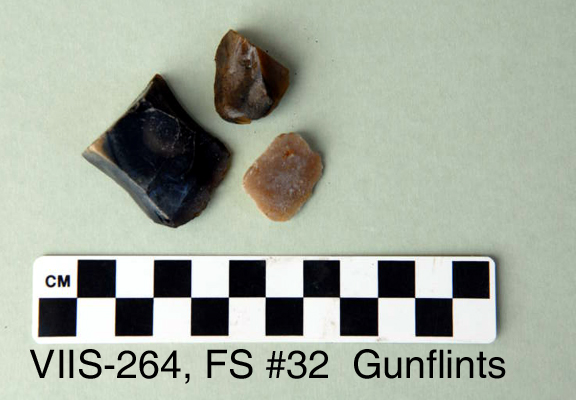
There were many additional discoveries and investigations, including anchors, chains, pulleys, cars and other tools associated with the careening operation. The team got a good look at an old, iron coaling vessel, a couple of cannons and some bollards. Yet perhaps the most intriguing finds are the gunflints along the northern shore. There must have been a significant shipwreck when Hassel Island was still connected to the mainland, and the ship must have been carrying a cargo of both British and French flint because the shoreline is littered with both flint nodules and finished gunflints. Perhaps our new Danish Interns will decide to study Hassel Island this year, and research the archives in Denmark for evidence of our theory. (More news on the new interns, scheduled to arrive in May, at a later date). The goal of all our work is to prevent the casual removal of these artifacts by individuals not with the park, whether during the trash removal on December 8th, or at a later date when the island receives more visitation.

This past Wednesday we had a special visit from Hassel Island’s first Ranger, Darcy Kulesha, and her husband, Ken. Darcy was working for the park in the early 1980’s when the park first acquired Hassel Island. At that time, the park was interested mongoose control, public relations and trash collection. Darcy said she had to drive from Redhook everyday and take a 15ft Boston whaler into Careening Cove where she would make her rounds. The team really enjoyed hearing her stories and as well, being able to show her progress in the revitalization of Creque Marine.

Lastly, it’s time to say goodbye to the derelict vessel that’s been stranded in front of the old Navy barracks at Careening Cove. The wreck is quite a site and more than a few people will miss the atmosphere it lends to Charlotte Amalie harbor. On the other hand, there are those who feel it an eyesore and certainly, a safety hazard. Seatow’s scheduled to have it gone by next week. Thanks again for reading.

Tuesday, November 13, 2007


Hello readers its Kourtney here an intern from the past that has come back to help with all the new projects in the park. In preparation for the beach cleanup project on Hassel Island, Ken, Susanna, and myself spent the day carrying out the preliminary work. Our work consisted of meeting with the SEATOW cleanup crew to plan how we are going to collaborate on the project. Our team will be responsible for the archaeological monitoring throughout the cleanup and vegetation removal. Additionally, hundreds of volunteers will be donating their time to help clean the Hassel Island beaches. Many of these will be local students.

Due to the numerous historic and two known prehistoric sites on the island, we need to make sure that the archaeological material is not mistaken for litter during the cleanup. In order to prevent disturbance of any cultural material, we will spend the next few weeks carrying out a field reconnaissance and controlled surface collections along the Hassel Island beaches.

Along the shore of Creque Marine Railway was our first find of the day, a copper ladle. We need to research how this artifact was related to the marine railway but of interest, it contained tar within the internal. This was found while meeting with SEATOW but the area has not been systematically surveyed as of yet. We decided to begin the survey along the East shore of the island. We walked along beach looking for surface artifacts, plotted these artifacts using the Trimble Navigation GPS (which can record points as accurate as 30 centimeters, and collected the artifacts accordingly. Along the beach, we found a variety of historic artifacts dating to the 18th and 19th centuries. The most common find was brick but there was also a great deal of fragmented ceramics (ie. annular ware, pearlware, yellow ware, stoneware, and course earthenware), historic glass bottles, ferrous metal (most of which was not collected), and a highly eroded mammal long bone.
As we made our way South along the beach, we began to find prehistoric artifacts. This site had been previously investigated by Ken and his team and he noticed that within the past two years, the site had been looted. There were three small depressions in the most concentrated area of the site that indicated people were digging there, most likely in search of artifacts. Also, two stone alignments had been laid out, creating a pathway that led from the beach to the site. On federal lands the removal of artifacts is very serious and can result in large fines and even prison sentences; they belong to all us.