Friday, February 29, 2008

Pipebowl Documentation


Pipebowl found on Hassel Island, Leprosarium/Yellow Fever Hospital Site
2-15-08

Monday, February 25, 2008

Hassel Island, Revisited

Mike Toomey with the pipebowl he found.
Greetings from the archaeology lab! The past few weeks have found the archaeology team hard at work down at Cinnamon washing, analyzing, dating, preparing, and cataloguing the melange of artifacts recovered from Hassel Island during the surface collection for the island cleanup back in November and December. This has given us a chance to review the artifacts both piecemeal and together as a awhole, revealing several trends. In this process, we have come a long way towards a better understanding of historic glass as Kourtney is working on a glass type collection that will make it easier for all of us next time to quickly determine a bottle's age and where it was made. This work with the collection has proved challenging as there are many different types of ceramics that indicate a wide range of dates of occupation. However, this is not surprising to us as we know that the island underwent many changes in occupation since early occupation in the 1600 hundreds and since the British first built Shipley's Battery in the late 18th century. We are continuing to work on the collection and looking forward to learning more about Hassel Island before we begin to accession materials from the Leprosarium/Yellow Fever Hospital and Shipley Battery.
Jillian clearing the path through pinquin up to Shipley's Battery

Last week, we returned several times to Hassel to work with SeaTow and to mark a suitable trail to Shipley's Battery, at the summit of the island. Our SeaTow pal, Michael Toomey kept his keen eyes to the ground and made a wonderful discovery of an impressivly intact decorative pipe bowl with stem. In recovering this artifact we recovered its UTM coordinates to exactly 10 centimeters; about the size of the pipe and stem itself. We're very glad to add this great artifact to our collection and thank Mike for his find and SeaTow for their very hard work. On the next blog we will try to post a closeup of this bowl that dipicts a harbor scene from the 1830s. Remember all never take artifacts form a National Park--The history of these objects belongs to all of us.


Ken explaining ancestory to the Antilles School Group


Susanna and the Guy Benjamin School Group


Guy Benjamin Students washing artifacts

In between our work with Hassel Island material and a successful folklife festival, we were glad to host two different third grade school groups to the archaeology lab who have been learning about the Taino. The first group from Antilles school learned about ancestors and saw the rare Zemis in the collection. The second group from Guy Benjamin were very helpful in washing artifacts and preparing them for analysis. We are always happy to share local archaeology with St. John students and hope that those very enthusiastic students will come back to volunteer for the Park in a few years!


Kulu Mele drumming at Annaberg Folk Life Festival
Mr. Guy Benjamin, first St. Johnian to graduate from High School

Friday, February 08, 2008

New intern at Cinnamon Bay!


Greetings VI National Park Service Friends! As the newest NPS intern, Jillian, I’m very excited to finally be here in St. John. I look forward to spending the next two months gaining a wide range of knowledge about the rich Caribbean history and prehistory preserved by the park.

This internship is part of my final internship requirement as a Master’s student in Museum Studies at George Washington University, in Washington D.C. I am originally from Buffalo, N.Y. and went to SUNY Geneseo for Anthropology, with minors in Geology and Spanish. At GW, I focus my studies mostly on the management and administration of natural history museums, so working here at Cinnamon Bay in an internship that covers a breadth of subjects such as curation, collections management, volunteer coordination, education, etc., I am in a very appropriate environment to tie together everything I’ve been studying for the past two years and see all museums functions connect in a very real way.

I arrived late Saturday evening to a warm welcome from Ken, Susanna and Kourtney. On Monday, Kourtney and I began a week of working with a group of volunteers from Elder Hostel. This is a band of people with an adventurous and enthusiastic attitude about what a vacation should be; they volunteer for a week for various community projects in exotic settings around the globe. This time, their travels brought them to St. John to continue a mapping project that had begun last year and is led annually by local historic architect Anne Hersh The first day of the week was focused on clearing overgrowth from the Leinster Guardhouse ruins that were choking the pathways around and inside the ruins. On Tuesday, the group moved over to Rustenburg plantation to flag, photograph, measure and map the sugar mill ruins. Kourtney and I worked to record accurate bearings and distances between the points that the volunteers were flagging and photographing while others worked to draw profiles of wall remains.
At the end of the week, Anne left with a wealth of information with which she intends to create a map of the ruins for the National Park Service to be able to add to its records. The exploratory spirit of the Elder Hostel volunteers is what allows us to add such valuable information to our archives!

I look forward to keeping you updated on the work that we are doing here this spring as we continue to uncover and preserve the history and prehistory here on St. John and right at home in the lab in Cinnamon Bay.

Monday, February 04, 2008

Soon Come

We've been busy! We will be posting an update shortly. Thanks!

Tuesday, December 18, 2007

Happy Holidays


At Cinnamon Bay, a tall ship sailing through Drake's Channel.


Season's Greetings. Ken, Kourtney, Katie, Amber and Susanna all wish everyone a very happy holiday and New Year. Ken was on the mainland for a week to attend the graduation of his daughter Lauren, who is receiving a bachelor of Environmental Science from Florida State University. We all want to congratulate Lauren on her accomplishment and wish here well in her future endeaevors. While Ken was away, some of the behind the scenes details were given our attention, such as environmental monitoring of the collection building, continuing research of the the human remains from Cinnamon Bay, conservation of the recently submerged artifacts and vegetation clearing. And Kourtney and Susanna had the pleasure of teaching 35 seventh graders about archeology and curation at the Cinnamon Bay Lab and future museum. Everyone had a great time and some important lessons were passed on, such as context, provenience, stratigraphy and the role of Hassel Island in the bid to purchase these islands from the Danes. In addition to learning about a real excavation from Kourtney, the students helped to wash several field sites Field Specimen ie(FS#'s) from the surveying at Careening Cove. Among the artifacts that were cleaned was a wide assortment of bottlenecks and glass bases. Although the kids were a big help and we enjoyed the group very much, we realized that we have a lot of work ahead of us in the cataloging of all the objects. In addition, we will need help from additional interns, so please continue to donate to the Friends in 2008, and thank you to all who donated in the past.
Students helping out with washing artifacts.


Seventh Graders from Sprauve School, Cruz Bay, St. John.


Hopefully, we can have Amber write the next posting about all her work in the lab with the conservation of the submerged metal. Stay tuned for some spectacular chemistry folks. Kourtney's work is also fascinating so when we all return from the Holidays be sure to check out the blog for updates.

This week, we recruited a new member to our team, NPS Wildlife Biologist Carrie Stengel. Carrie was instrumental in instructing the team on the proper use of herbicides that will curtail the growth of exotic and invasive species at the Creque Marine Railway. We really don't want to see this stucture covered in catch and keep for a very long time so it will take maintenance to keep the site open. Stay tuned for opportunities to help in the revitalization of the Creque Marine Slipway and other sites on Hassel Island.
View out of the winch house, Creque Marine.

Also on Hassel Island, the old iron wreck in Charlotte Amalie mentioned in the previous post is simply no match for Rocky, Toby and Chris from Seatow. Although the work is slow and dangerous, the Seatow crew is taking apart the ship piece by piece. (Unconfirmed sources report that this ship was commissioned by an infamous German leader during WWII.) The difference to the island from the beginning of November to now is truly remarkable, and thank you again to everyone that is helping to keep Hassel Island safe and secure for future generations.

Seatow's crewman Chris working on the awesome wreck.

Sunday, December 09, 2007

Maintenance is Preservation


Operation Clean Sweep 2007 was a thorough success and a good start. With well over 200 people participating, the beaches of Hassel Island were swarming with volunteers picking up trash. The crew got an early start to catch the 6am barge in order to be in Crown Bay for the organizational meeting. Our mission was to educate on the island's history, make sure nothing important was put in the trash and coordination. Following the briefing, we then boarded a vessel provided by Coral World, that took the groups to Creque Marine and Careening Cove. The weather was bright yet blustery so the vessel had a hard time docking at Careening Cove. Thankfully, Seatow was on hand to ferry the kids boat by boat to the cleanup site. The groups of school kids were fantastic and did a great job; it was really a site to see years of trash finally coming off the shores. “Hassel Island Clean Sweep” was launched in cooperation with Virgin Islands National Park Service, the St. Thomas Historical Trust, the Friends of Virgin Islands National Park, Essence Properties, Inc., Sea Tow Virgin Islands, and other entities in the Virgin Islands Government.


Disembarking at Creque Marine.
Seatow's Captain Alan Wentworth ferrying the groups over to the beaches.
Happy ROTC students with Honorable Delegate Donna Christenson


...and some of the kids that made it happen

After running out of trash bags, it was time for lunch. Again, all the students were ferried back to Mr. Sharaf's property on Hassel Island for a celebratory BBQ. Everyone then got T-shirts that read "Maintenance is Preservation." It was a great day and thanks to everyone for all the work. Now that the initial clean up is done, we hope to get a chance to map/gps the historic hardware around the Slipway and to document the many objects that were hidden from view.

Elvis, Kourtney, Ken Katie, Susanna

Friday, November 30, 2007

At last, the Cultural Resource Team has internet access and a day in the office. For the past two weeks, with the exception of Thanksgiving, we’ve been on Hassel Island conducting surface collections in advance of the wave of volunteers scheduled for Dec 8th and monitoring the progress being made by the Seatow crew in the cleanup of the bays. For the first time in decades, there is now a 50ft swath up to the Winch House at Creque Marine. Many people have waved at us from their boats and told us to keep up the good work and this is especially true of the Seatow crew.
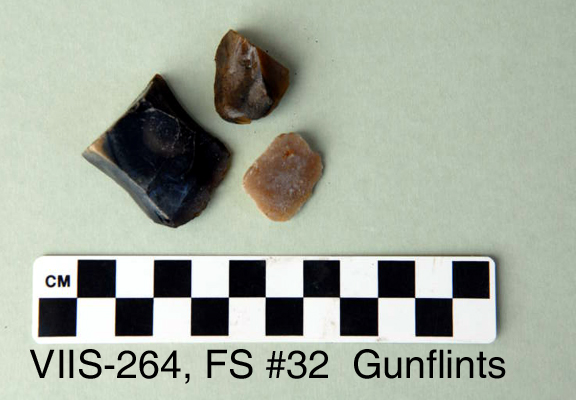
We’ve completed the preliminary surveys of Careening Cove, Palm Grove and are almost done with the Creque Marine Shoreline. Each site has yielded significant diagnostic artifacts, as seen above, and everyday our backpacks have been heavy with artifacts that are being brought back to the lab in order to by washed, analyzed, cataloged and preserved. We are all looking forward to the analysis of the hundreds of bottlenecks and bases we’ve collected and after the cataloging is complete, we plan on using some of our finds to create a new type collections of bottles, and perhaps add to existing ceramic type collections.
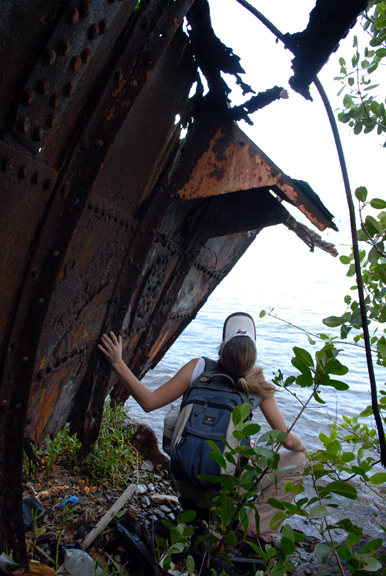
There were many additional discoveries and investigations, including anchors, chains, pulleys, cars and other tools associated with the careening operation. The team got a good look at an old, iron coaling vessel, a couple of cannons and some bollards. Yet perhaps the most intriguing finds are the gunflints along the northern shore. There must have been a significant shipwreck when Hassel Island was still connected to the mainland, and the ship must have been carrying a cargo of both British and French flint because the shoreline is littered with both flint nodules and finished gunflints. Perhaps our new Danish Interns will decide to study Hassel Island this year, and research the archives in Denmark for evidence of our theory. (More news on the new interns, scheduled to arrive in May, at a later date). The goal of all our work is to prevent the casual removal of these artifacts by individuals not with the park, whether during the trash removal on December 8th, or at a later date when the island receives more visitation.

This past Wednesday we had a special visit from Hassel Island’s first Ranger, Darcy Kulesha, and her husband, Ken. Darcy was working for the park in the early 1980’s when the park first acquired Hassel Island. At that time, the park was interested mongoose control, public relations and trash collection. Darcy said she had to drive from Redhook everyday and take a 15ft Boston whaler into Careening Cove where she would make her rounds. The team really enjoyed hearing her stories and as well, being able to show her progress in the revitalization of Creque Marine.

Lastly, it’s time to say goodbye to the derelict vessel that’s been stranded in front of the old Navy barracks at Careening Cove. The wreck is quite a site and more than a few people will miss the atmosphere it lends to Charlotte Amalie harbor. On the other hand, there are those who feel it an eyesore and certainly, a safety hazard. Seatow’s scheduled to have it gone by next week. Thanks again for reading.

Tuesday, November 13, 2007


Hello readers its Kourtney here an intern from the past that has come back to help with all the new projects in the park. In preparation for the beach cleanup project on Hassel Island, Ken, Susanna, and myself spent the day carrying out the preliminary work. Our work consisted of meeting with the SEATOW cleanup crew to plan how we are going to collaborate on the project. Our team will be responsible for the archaeological monitoring throughout the cleanup and vegetation removal. Additionally, hundreds of volunteers will be donating their time to help clean the Hassel Island beaches. Many of these will be local students.

Due to the numerous historic and two known prehistoric sites on the island, we need to make sure that the archaeological material is not mistaken for litter during the cleanup. In order to prevent disturbance of any cultural material, we will spend the next few weeks carrying out a field reconnaissance and controlled surface collections along the Hassel Island beaches.

Along the shore of Creque Marine Railway was our first find of the day, a copper ladle. We need to research how this artifact was related to the marine railway but of interest, it contained tar within the internal. This was found while meeting with SEATOW but the area has not been systematically surveyed as of yet. We decided to begin the survey along the East shore of the island. We walked along beach looking for surface artifacts, plotted these artifacts using the Trimble Navigation GPS (which can record points as accurate as 30 centimeters, and collected the artifacts accordingly. Along the beach, we found a variety of historic artifacts dating to the 18th and 19th centuries. The most common find was brick but there was also a great deal of fragmented ceramics (ie. annular ware, pearlware, yellow ware, stoneware, and course earthenware), historic glass bottles, ferrous metal (most of which was not collected), and a highly eroded mammal long bone.
As we made our way South along the beach, we began to find prehistoric artifacts. This site had been previously investigated by Ken and his team and he noticed that within the past two years, the site had been looted. There were three small depressions in the most concentrated area of the site that indicated people were digging there, most likely in search of artifacts. Also, two stone alignments had been laid out, creating a pathway that led from the beach to the site. On federal lands the removal of artifacts is very serious and can result in large fines and even prison sentences; they belong to all us.

Friday, October 05, 2007

GPRA, GMP, CMR and PMIS


Brown Bay Ruins
Although September is usually a quiet time for the Virgin Island, we've been very busy under the new directives of Superintendent Mark Hardgrove. Mark brings a wealth of experience and expertise of NPS Cultural Resources and is already making the preservation of historic ruins a high priority. It is a breath of fresh air and all the hard work that has been accomplished by Ken and his interns in the past will hopefully be rewarded with increased funding. It is a very exciting time to be working here and we will surely be reporting on many important developments, so stay tuned....

Josie's Gut Ruins

The first thing that happened was a visit by NPS Contractors. Last week, the Cultural Resource team completed a monumental survey of the historic resources. Ken, Katie, Susanna and Jackie, the contractor, managed to do site surveys of Annaberg, PeaceHill, Denise Bay, Caneel Bay, Catherineberg, Rustenberg, Trunk, Cinnamon, Leinster, Lameshur, Yawzi, Reef Bay, Genti, Josie's Gut, Brown Bay, Betty's Hope, Mary's Point, several cemeteries, and Hassel Island. All of this effort was to document structures in order to hopefully obtain funding for preservation. There was so much to do that the team did not finish their work until 7 pm, Friday night and Jackie found out just how hard it is to get into some of these ruins. Like all interns, she was a good sport about all the catch and keep, acacia, mosquitos and the long swim between the boat and Reef Bay Beach. We hope she has some wonderful memories of her time on St. John while writing her reports up in the mainland. Thank you Jackie.

Par Force Village

Lameshur

This week, a little more time was spent in the office working on the annual goal reporting(GRPA), the project management information system(PMIS) and writing documents for the General Management Plan(GMP). In addition, the park submitted the annual collection management report(CMR) to Washington and reported that it had cataloged over 3585 objects in FY 2007. Thanks to all the volunteers and interns who helped to get that done!

We've often discussed the idea of featuring a object from the collection with each blog. Susanna picked the one for this week, Sadly, the island lost one of it's world famous residents this week, Miss Lucy. Many locals and visitors knew her through her restaurant in Coral Bay and as the St. John taxi driver who "wore a hibiscus in her hair and drove a taxi decorated with a set of goat horns dripping flowers." Our condolences go out to her family and the NPS is proud to have in their archives, this picture taken of Miss Lucy and her taxi in 1962. Her full obituary may be found at http://www.onepaper.com/stjohnvi/?v=d&i=&s=News:Local&p=1201842501

Thursday, September 13, 2007

Shipwreck Archaeology


Greetings! For faithful readers, I suppose this is a reintroduction. I’m Katie and I was fortunate enough to be a NPS Archaeology intern for an all too brief stint last summer. I had to go back to Florida to finish my undergraduate degree in Anthropology, but I’m finally back! I thought my first experience here was absolutely too good to be true, so it’s hard to believe I now have the chance to continue learning from Ken and Susanna.
We got off to a roaring start this week with two surveys of a shipwreck at. It felt great to be back out on the water! This was my first experience with shipwreck archaeology so I wasn’t sure what to expect. We entered a shallow, protected cove to find, well… it looked like nothing at all. We saw plenty of sand, fish, coral, and some beautiful anemones but, no sign of a ship. I got inspired when Ken started fanning around, what looked like and ordinary pile of rocks, and found that it was actually a ballast pile and peice of metal left from the ship. After a few false alarms (I thought an old coconut was a cannonball), I actually managed to find something. It was a shiny piece of copper sheathing with one little tack still hanging from the corner. The salt water had turned it gold, teal and pink and Ken said it was probably used to cover the bottom of a historic ship. After consulting with Peter Fix, an archaeologist and conservator at Texas A&M University, Ken found out that copper sheathing was used for the first time in 1761 to prevent marine worms from damaging the bottoms of wooden ships. The HMS Alarm was the first ship to recieve this form of protection. This date corresponds with several other artifacts that were recovered from the site in 2002 including a lead gaming peice and a pearlwear ceramic bowl rim shard. I got a refresher course on proper collection technique and learned how to use the GPS to record its exact location. Ken also found a piece of wood from the shipwreck with hand wrought, iron nails intact. We photographed it and recorded its location before burying it back in the sand. I was extremely excited to bring the copper back to the lab and I can’t wait to work on preserving it with Amber!

Thursday, July 19, 2007

Discoveries at Creque Marine Railway and My Last Post!

Hello, faithful archeology blog readers! This is my last post as a Virgin Islands National Park intern, and it’s going to be a long one. Ken, Susanna and I all fly out within the week—Ken and Susanna for month-long breaks and myself for home in NH. I would like to say that it’s been a wonderful experience to be an intern for the Cultural Resources Management Division of the VINP. I have learned a great deal about the history of the islands, about archeology and cultural resource protection, and about the National Park Service. I was fortunate to be involved in some exciting projects (see previous posts) and fortunate to travel places I would never have seen had I not been working with the Park. I want to thank Ken Wild and the Friends of the VINP for this opportunity and both Ken and Susanna for teaching me so many things. Well, without further adieu, I’ll get to the post, but not before wishing the next intern good luck!


(me looking through a rusted out boiler at Hassel Island)

A couple weeks ago in early July, Ken, Susanna, and I teamed up with Park Ranger Dylan to help him remove an unregistered fish trap from Hawksnest Bay. It is one of the park’s objectives to find and remove any abandoned fish traps within our boundaries because the traps will keep killing fish over and over again. A French grunt was caught inside and so a nearby sailboat lent us a pair of wire cutters to free the fish. Afterwards, Dylan and I snorkeled around Honeymoon Beach looking for evidence of anchor scarring while Susanna and Ken dove. A large vessel with an entirely metal chain had anchored within the park boundaries the week before, and Dylan wanted to investigate the extent of the damage. Susanna took photographs of broken and toppled coral heads in case the offender attempted to dispute the ticket he was given.
The third dive of the day consisted of Ken and Susanna surveying a mooring off Caneel Bay. The Cultural Resources Management division is responsible for completing a certain amount of surveys per year. When the park moorings were put in years ago, no archeological investigations were performed to insure that for example, a shipwreck wasn’t being damaged in the process. Therefore, we are slowly surveying each mooring around the island to look for any indication of cultural deposits. Its actually a perfect random sample approach. I was surface support for this dive; however, I learned I could free dive to 32 feet when I had to retrieve the boat hook I dropped over the side:) All in all, it was a fun and productive day on the water.
In other news, a great stride has been made in the Creque Marine Railway Restoration project. For the past two weeks, Stefferson Marine and Construction has been clearing metal debris out of the Creque Marine slipway.

(Randy and Lalo loading debris onto a platform)

The Cultural Resources Team monitored the work in case any historic artifacts were recovered…and there were! Several bollards were found that would have originally been attached to the sides of the slipway, but must have fallen into the water when sections collapsed. FYI, a bollard is a short, vertical iron post used to tie the lines, i.e. ropes, of a shi (left). An iron wheel about 1.5’ in diameter was also found that would have originally been used as part of the railway to haul ships out of the water for repair (below). Also a porthole from a large ship (below). On Wednesday the 18th, the last day, Lalo found an intact small porthole in beautiful condition (above) .
Now that the slipway is cleared of debris, a barge will be able to land so that materials can be unloaded for structure stabilization and metal artifact conservation. There’s a lot of work to be done to restore Creque Marine Railway for visitation by the public, but I am excited that the entire process has been jump-started and I look forward to seeing it completed someday.
The marine rails were found to be well preserved underwater.

We wanted to let you know there is an article in American Archaeology (on news stands) about the Tainos titled “Before and After Columbus.” It mentions the archeology at Cinnamon Bay and pictures some of the artifacts recovered by the Park Service as well as other interesting sites around the Caribbean. New discoveries are shedding more light on the Tainos’ way of life.

Well, I think I’ve reported all I can. Everyone, wish St. John well in the hurricane season and stay tuned in September for the next post. Thanks for reading!

Amber Davis


Thursday, June 21, 2007

A New Prehistoric Lithic Site

Hello, readers! Amber Davis is back in the driver’s seat, a.k.a. I am writing the blog again and excited to be doing so. Whew! Things have slowed down a bit after the departure of the Danes on June 2nd—less field work, more office work. Ken has been preparing a field report and I have drawn two maps for Laura and Jonas to use in their 50-page paper for the University of Copenhagen. Good luck, both of you! The paper will be written in English and it will focus on the early history of Lameshur Bay on St. John. We will make it available to the general public, so stay tuned if you’re interested.


In other news, after completing a test excavation at the ruins of an early plantation, Ken, Susanna, and I hiked out to a point on the south shore and discovered a prehistoric lithic scatter. We got GPS points on two large lithics recovered that could either be tools or the by-product of tool manufacture. The archaic people that settled on St. John did not refine their everyday, utilitarian stone tools and so it can be difficult to distinguish between the tool and the refuse. We also discovered a manuport, which Ken explained to me was a stone found out of its original context that was used as a tool by humans. However, the stone was not modified by a human. Our manuport is a rounded rock that would have originally been found on a beach, but we found it atop the cliff where the archaic people likely brought it to prepare food with. Lastly, one beautiful lithic tool was also recovered that may be notched (see picture below, the small square stone). This lithic site may date to 400 B.C. because another archaic site, with similiar tools, at a nearby bay was carbon-dated to this early period.


Over the next few weeks, the team has a busy schedule. We will be surveying the spine of Hassel Island to assess the conditions of various archeological sites and structures. Catch-and-keep, be afraid:) Also, the purchase of chemicals and equipment for metal artifact conservation has been approved, so I will be monitoring the pH of our wet-storage vat and determining chloride concentration very soon (vat seen below with artifacts) .


Thanks for visiting the blog and see you soon.


P.S. I'm writing this post script a couple weeks later than the blog because it is just too interesting to wait for the next blog...We have rediscovered an RPG in our archives that we would love to know more about. FYI, an RPG is a rocket-propelled grenade, and this artifact shown below was found at a tent site at Cinnamon Bay campground. We have no expertise with military artifacts, and so we are asking if any readers do have valuable knowledge. Just reply to this post or you can email ken_wild@nps.gov with tips. Thanks!